
Registration & Verification
Proof of Address Rejected by Binance: What Actually Counts
Address verification fails for reasons that have nothing to do with your address — wrong document type, stale issue date, redacted fields, or a mismatch with your account profile.
Address proof is a stricter check than ID
Identity documents are standardised, machine-readable and designed to be verified. Address documents are none of those things — they are ordinary correspondence from banks, utilities and government offices, in hundreds of formats. Because the format cannot be relied upon, the checks lean much harder on four specific properties instead.
Understanding those four properties is the whole game, and it explains most rejections that otherwise look arbitrary.
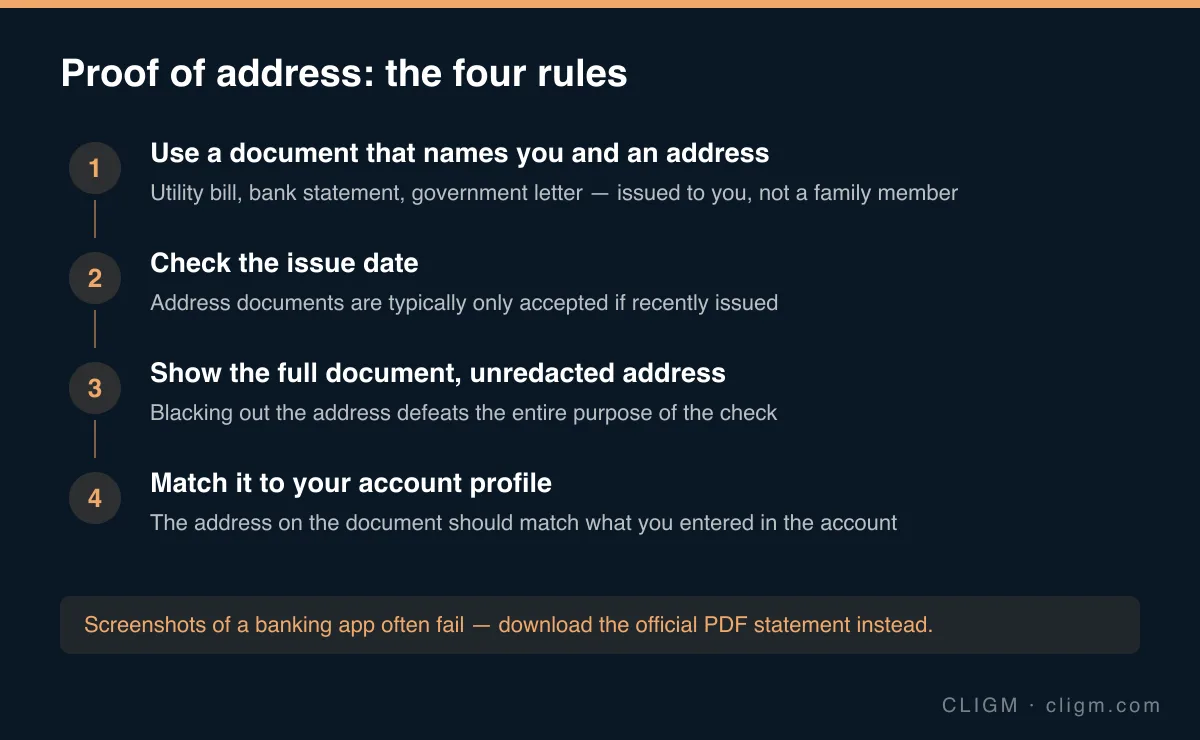
One: the document must link your name to an address
Both parts are required, in the same document. A utility bill in your partner's name proves an address but not that you live there. A letter addressed to you with no address printed on it proves nothing at all.
This is the most common failure for people who live with family or in shared housing, where the bills are rarely in every resident's name. The usual routes out are a bank statement, a tax or government letter, or an official residence registration — documents that are individually addressed to you regardless of who pays the utilities.
Commonly accepted categories are utility bills, bank or card statements, government-issued letters including tax correspondence, and in some regions tenancy agreements or residence certificates. What is accepted in your specific country appears in your own verification screen; treat that list as authoritative rather than a general one.
Two: the issue date must be recent
Address checks are trying to establish where you live now, so a document issued long ago does not do the job even though the address on it is correct. Recency requirements vary by region and are stated in the upload screen — read them there rather than assuming.
The practical trap is annual documents. A yearly tax statement or an insurance renewal is often outside the accepted window for most of the year. Monthly bank statements and utility bills are the reliable option because a fresh one exists every month.
Make sure the issue date is actually visible on the page you submit. Some statements print the date only on the first page or in a footer that gets cut off.
Three: do not redact the address
This sounds obvious, and yet it is a frequent cause of rejection. People reasonably want to hide account numbers and balances before uploading a financial document — and then black out slightly too much, or use a redaction that also covers the address block or the name.
You may generally obscure sensitive financial figures such as balances and full account numbers. You must leave your full name, your full address and the issue date completely legible, along with the issuer's identity. If the redaction makes it ambiguous which parts of the document were altered, the whole file becomes untrustworthy to a reviewer.
Never edit the address itself. Correcting a typo, updating an old address or "tidying up" the formatting turns a rejected document into a falsified one.
Four: it must match your account profile
The address stored in your Binance account profile and the address printed on the document need to describe the same place, in a recognisably similar way. Different abbreviation of a street type is fine. A different apartment number, a different postal code or a different city is not.
If you have moved, update the profile address first and then submit the document for the new address. Submitting a new address against an old profile entry produces a mismatch rejection that looks, unhelpfully, identical to a document-quality rejection. If the move is to another country, that is a bigger process — see moving country with a verified account.
Getting the file itself right
Download the official PDF from your bank or utility provider rather than screenshotting the app. In-app screens are designed for phones — they often show a truncated address, no issue date and no issuer letterhead, which is exactly the information the check needs.
For a paper document, photograph the full page flat, with all four corners in frame, in even light, with no fingers covering text. The same capture discipline that applies to identity documents applies here.
If the address step keeps failing after you have satisfied all four properties, check your in-app messages for a specific document request before submitting anything further — and if the status is simply not moving, read what "under review" means.
CLIGM is an independent guide and is not affiliated with Binance. Verification requirements, accepted documents and available products differ by region and change over time — always confirm the current rules inside your own account or in official Binance support material. Last reviewed: August 2026.