Registration & Verification
Moved Country With a Verified Binance Account? Do This in Order
Relocating changes which rules apply to your account. Updating residency properly is slower than hiding the move — and enormously safer.
Your account is tied to a jurisdiction, not just to you
A verified account carries a country of residence, and that field does more than sit in your profile. It determines which entity holds the relationship, which products you can access, which fiat rails are available, what limits apply, and which local regulations govern the account.
When you move, all of that should move with you. It does not happen automatically, and leaving it stale creates a growing mismatch between where the account thinks you are and where you actually are — a mismatch that tends to surface at the worst possible moment, typically during a withdrawal.
Start by not hiding it
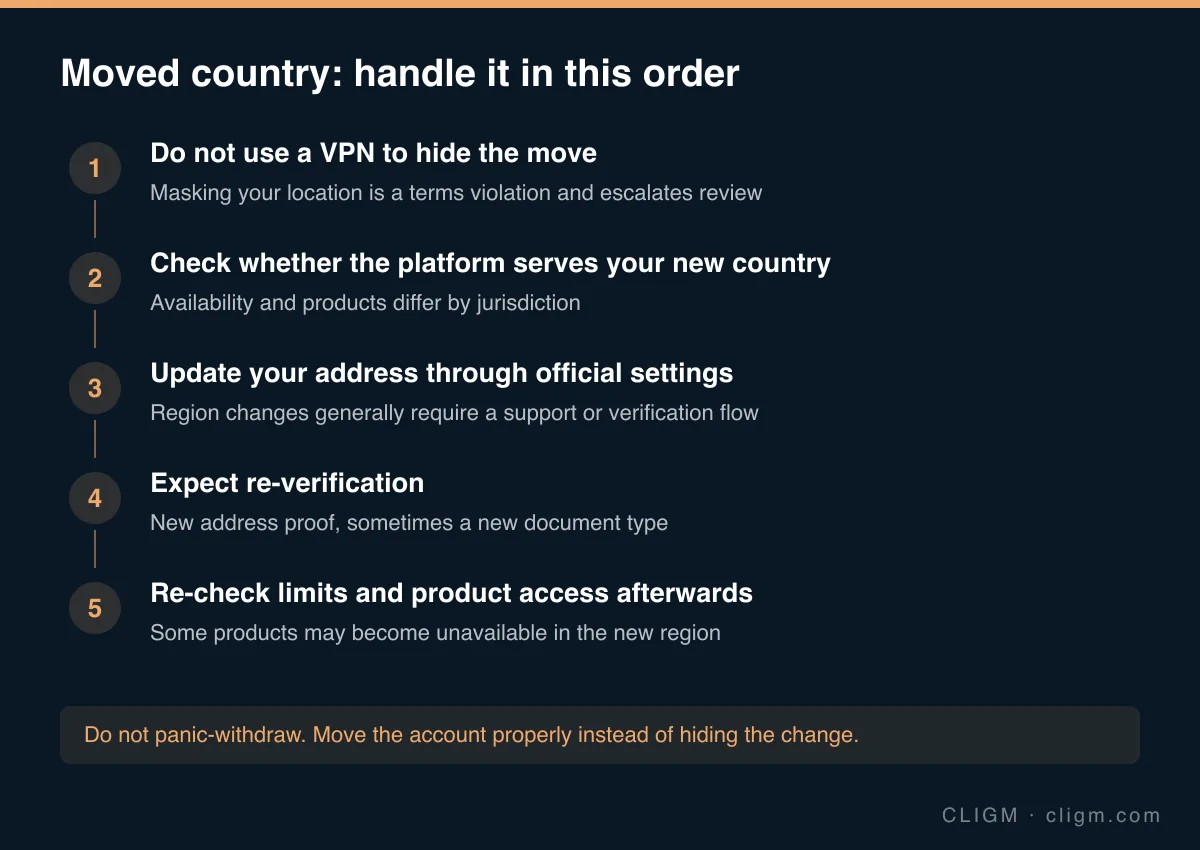
The tempting shortcut is to change nothing and use a VPN when the location seems to matter. It is worth being direct about why this backfires.
Masking your location is a terms violation in its own right. It is also detectable through many signals other than IP address — payment instruments, phone number, device and behaviour patterns. And a location mismatch is exactly the kind of anomaly that triggers a risk-control review, which is how people end up with a suspended withdrawal at the precise moment they need funds.
The failure mode is bad: the account is frozen pending review, resolving it requires disclosing the move anyway, and now it looks like concealment rather than an ordinary relocation. The honest route is slower to start and dramatically faster to finish.
Check availability before you change anything
Before you touch the account, find out what your new country actually supports. Availability differs sharply between jurisdictions — some products are unavailable, some fiat routes do not exist, P2P may or may not operate, and in a few countries services are restricted altogether.
Do this while you still have full access. If a product you rely on is not offered where you are moving, you want to know that before you are mid-transition, so you can plan an orderly exit from that position rather than an urgent one.
Update residency through official channels
Region changes are generally not a free-text profile edit. Because the country field has regulatory consequences, changing it usually runs through a support or verification flow rather than a settings toggle.
Look for a residency or region option on your verification page first. If there is none, open an official support request from inside the app and explain the relocation plainly: where you were, where you now live, and from when. Do not start this from a link in an email — fake support targets exactly these transitions, because a user in the middle of a country change is primed to expect unusual requests for documents.
Expect to verify again
Plan for re-verification rather than being surprised by it.
You will likely need a proof of address for the new country, which is often the hardest document to produce right after a move — bills and statements at a new address take time to exist. Getting a bank account or utility connected early makes this much easier. The proof of address requirements are worth reading before you submit, because the recency window catches people out.
You may also be asked for a new identity document if your previous one was issued by a country you no longer reside in, and possibly for documentation of your residency status such as a visa or residence permit.
After the change
Re-check three things once the update completes.
Limits, which may be different under the new region's rules even at the same verification tier — see verification levels for why tier is only one input.
Product access, in case something you used is not offered locally.
Payment methods, since cards and bank accounts registered in your old country may no longer work, and adding local ones is usually necessary.
If the account cannot follow you
Occasionally the answer is that services are not offered where you now live. It is not the outcome anyone wants, but there is a correct way to handle it: withdraw your balances in an orderly way, export your complete transaction history for tax purposes, and close the account properly. Closing an account safely covers the sequence.
What is not a solution is keeping the account under a country you have left, or opening one under someone else's identity in the new country. Both convert a manageable inconvenience into a permanent loss of access to funds.
CLIGM is an independent guide and is not affiliated with Binance. Verification requirements, accepted documents and available products differ by region and change over time — always confirm the current rules inside your own account or in official Binance support material. Last reviewed: August 2026.