
Fees & P2P
Binance Dust: What to Do With Balances Too Small to Trade
Those tiny leftover balances that refuse to sell? That is dust — a mechanical byproduct of minimum order sizes. Three clean ways to handle it, and the fee traps to skip.
Sell a coin, and somehow a sliver of it stays behind. Try to sell the sliver, and the exchange refuses — amount too small. Multiply by every asset you have ever traded, and your wallet becomes a museum of unsellable fragments. This is dust, it happens to literally everyone, and it says nothing about your competence. It is a mechanical byproduct of how order sizes and fees interact. This guide explains why it forms, the three legitimate ways to deal with it, and the fee traps that turn a cosmetic annoyance into an actual loss.
Why dust forms at all
Every Spot market enforces minimum order rules — a minimum quantity, a minimum notional value (the amount times the price), or both. Any balance below those thresholds cannot form a valid order, so it cannot be sold. Dust accumulates through ordinary mechanics: fees taken in the traded asset leaving remainders, percentage-based sells leaving fractions, price movements pushing a once-valid balance below the notional minimum, tiny airdrops and distribution payouts, and rounding at every step. None of this is an error. Notably, dust is also harmless: it costs nothing to hold, does not decay, and has no deadline. That fact should anchor everything you decide below.
Option 1: the small-balance conversion tool
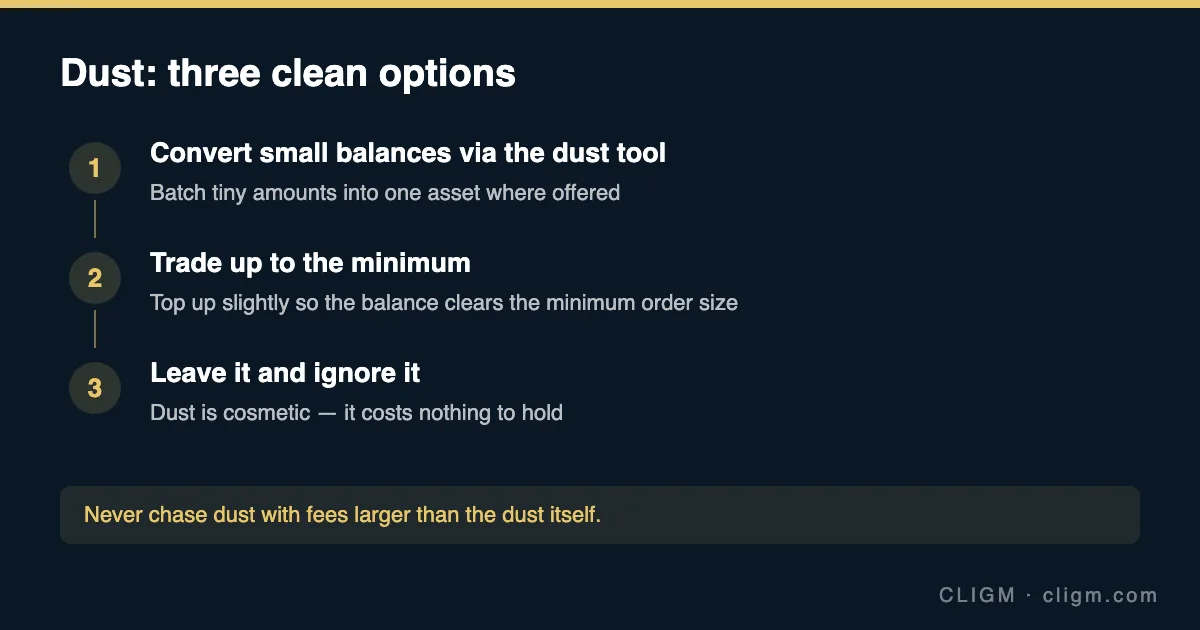
Exchanges know dust is universal, so Binance provides a purpose-built fix: a small-balance conversion feature that batches eligible tiny balances and converts them into a single asset (historically BNB) in one action, below normal minimum-order rules. In your wallet view, look for the option to convert small balances — it lists which of your fragments are eligible, lets you select several at once, and shows the conversion terms before you confirm.
Three practical notes. Eligibility varies: some assets are excluded, and balances above a certain size do not count as "small" — those you handle with Option 2. There is usually a cooldown between uses, so gather everything in one batch rather than converting piecemeal. Check the terms on the confirmation screen: the conversion applies its own rate and any fee is disclosed there — the screen you are looking at is authoritative, not any third-party description of it (this article included).
Option 2: top up to the minimum
For balances too large for the dust tool but still below trading minimums, invert the problem: buy a little more of the asset so the combined balance clears the minimum order size, then sell the whole position in one order. You end holding zero of the asset, which was the goal. The judgment call is whether the leftover is worth a round trip of fees — for a fragment worth a few cents, it rarely is; for a mid-sized leftover it often is. Where minimum order rules for each market actually live: the trading rules page for the pair, and the error message itself usually names the constraint you missed.
This is also the moment to remember the total-cost lens from Binance fees explained: a top-up-and-sell involves two orders' worth of fees and spread. If the point is consolidation rather than exit, Convert sometimes routes small amounts more gracefully than the order book — compare final amounts, as always.
Option 3: ignore it
Genuinely underrated. Dust has no carrying cost, and a wallet interface's "hide small balances" toggle removes the visual clutter that is dust's only real harm. If the fragments bother your sense of order rather than your finances, the toggle is the entire solution. Revisit during a periodic cleanup — monthly, quarterly, whenever — batch everything through the dust tool once, and move on.
The traps: how dust cleanup loses money
Chasing dust with fees larger than the dust is the classic. A fragment worth pennies is not worth a paid action of any kind — and this trap generalizes: any "cleanup" whose fees exceed the amounts being cleaned is a donation with extra steps.
Never withdraw dust. Withdrawal fees are flat per-transaction amounts, not percentages — for a dust-sized balance the fee can exceed the balance many times over, and minimum withdrawal amounts usually block it anyway. Consolidate first (Options 1–2), withdraw once, if at all. How withdrawal fees stack with network choice is covered in choosing the right network.
Beware "dust attack" paranoia — and dust-themed scams. Receiving unexplained tiny deposits of a random token is usually a mass distribution or, on some chains, a tracking technique aimed at self-custody wallets — inside an exchange account it is a non-event. The actual risk arrives socially: tokens whose names are URLs, or DMs "explaining" your mystery deposit and offering to help you claim, swap or recover it. Interact with none of it — do not visit token-name URLs, and treat unsolicited helpers exactly as described in the phishing field guide. You never need outside help to handle a balance inside your own account.
A two-minute routine that prevents accumulation
When exiting a position, sell by quantity you hold rather than a percentage where the interface allows it, and prefer fee settings that do not deduct from the traded asset (BNB-fee options, where enabled, leave cleaner exits). Then once a quarter: unhide small balances, batch-convert the eligible ones, top-up-and-sell anything mid-sized you want gone, re-hide the rest. Dust never fully stops forming — but it stops mattering.
CLIGM is an independent site and is not affiliated with Binance. Tool availability, eligibility rules, cooldowns and conversion terms vary by account and region and change over time — the screens in your own account are authoritative. Last reviewed: July 27, 2026.