
Fees & P2P
Binance Convert vs Spot: Which Actually Costs Less?
Convert shows no fee; Spot shows one. That tells you nothing about which is cheaper. Here is where each one's cost actually lives, and a two-minute test that settles it for your amounts.
Convert says "zero fees" and Spot itemizes a fee on every trade — so Convert is cheaper, right? Not necessarily, and often not at all. The two products price the same swap differently: one shows its cost as a line item, the other embeds it in the exchange rate. Neither presentation tells you which is cheaper for your trade. This guide explains where each cost actually lives, when each product genuinely wins, and gives you a two-minute test that beats any table of third-party numbers — including ours, which is why this article deliberately contains none.
Where Convert's cost lives
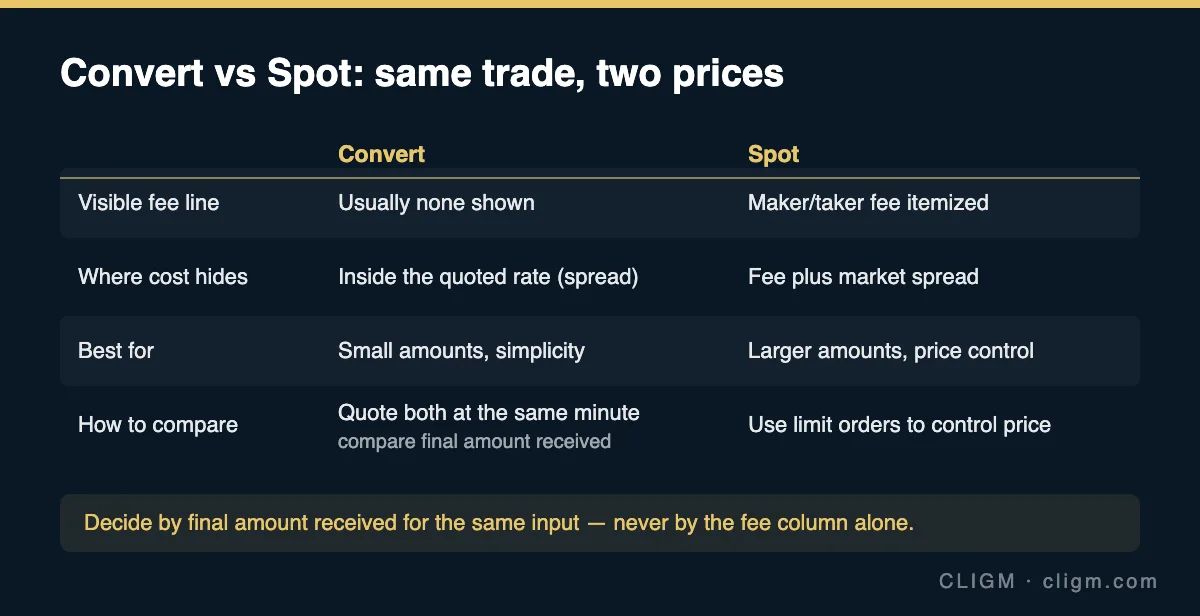
Convert quotes you a fixed rate: this much USDT for that much BTC, guaranteed for a few seconds. No fee line appears because the cost sits inside the quoted rate — the difference between the rate you are offered and the mid-market price at that moment is the spread, and the spread is the price of the service. This is not a criticism; it is how quote-based products work everywhere (it is also how most fiat currency exchange works). You are paying for simplicity, a locked-in rate with zero slippage, no order book to understand, and coverage of small amounts that the order book handles poorly.
The practical consequence: Convert's cost is invisible but real, and it varies. Spreads widen when markets move fast, in less liquid pairs, and at odd hours. The same conversion can cost noticeably different amounts on a calm Tuesday versus a volatile night — without the interface ever showing a different "fee".
Where Spot's cost lives
Spot trading charges an explicit fee — a percentage of the executed amount, itemized on every fill — plus whatever the market itself costs you: the bid-ask spread and, for market orders, slippage on thin books. Two things move the fee: your fee tier (based on account activity and holdings) and whether your order is maker or taker. A maker order adds liquidity (a limit order that rests on the book); a taker order removes it (a market order, or a limit order that fills immediately). Maker rates are typically lower — and a common misconception is that limit orders are automatically maker orders: a limit order priced to fill instantly executes as taker. Your current rates are shown in your account's fee page and, more usefully, in the order confirmation before you commit. BNB-based fee discounts, where enabled, change the arithmetic further — check what your account actually applies rather than assuming.
The comparison that actually works
Forget generic advice — run this test with your own amounts, because spreads and tiers are specific to you:
- Pick the exact swap you care about (say, USDT to BTC) and the exact amount.
- Same minute: get a Convert quote, and look at the Spot order book for the pair — note what your amount would fill at, plus your fee rate from the confirmation screen.
- Compare one number only: final amount received. Not the fee column, not the rate presentation — the amount of the target asset you end up holding.
- Repeat once during a volatile hour if you trade in volatile hours, because that is when the two products diverge most.
This is the same "total cost" logic that governs every path through the exchange — spelled out in Binance fees explained — applied to a single fork in the road.
When each one genuinely wins
Convert tends to win when: the amount is small (explicit fees and minimum order sizes bite proportionally harder); the pair is obscure (Convert can route pairs that have no direct order book); you need it done in ten seconds without thinking; or the balance is too small to trade on Spot at all — a scenario with its own tricks, covered in what to do with dust balances.
Spot tends to win when: the amount is meaningful (a percentage fee you can see is usually tighter than a spread you cannot); you can use a resting limit order and collect the maker rate; the market is calm and liquid; or you care about executing at a specific price rather than "about now". For larger amounts the gap is not subtle — spreads scale with the amount silently, while Spot fees stay a visible, predictable percentage.
A hybrid worth knowing: for a mid-sized swap in a liquid pair, a patient limit order at maker rates is usually the cheapest tool Binance offers a retail user. Its price is your time: the order may not fill, and an unfilled order during a moving market has its own cost.
Three habits that save more than product choice
First: decide by final amount received, always. It is the only number that cannot mislead you, across any product or presentation. Second: avoid trading during spikes unless you have a reason — both spreads and slippage widen exactly when everything feels urgent. Third: do not chain conversions. Every hop pays the cost again; converting A→B→C because the direct pair did not occur to you doubles your spend. Check for a direct route first, on either product.
And remember that the swap is rarely the whole journey — if the asset is leaving Binance afterwards, withdrawal and network fees join the total, which is where the full-path math in the fees guide takes over.
CLIGM is an independent site and is not affiliated with Binance. Fee tiers, spreads, discounts and product availability vary by account and region and change constantly — the live quote and order confirmation in your own account are the only authoritative prices. Last reviewed: July 27, 2026.