
Fees & P2P
Binance Fees Explained Without Guessing: What to Check Before You Pay
Understand the difference between trading, spread, withdrawal, network, card, bank and P2P costs without relying on stale fee tables.
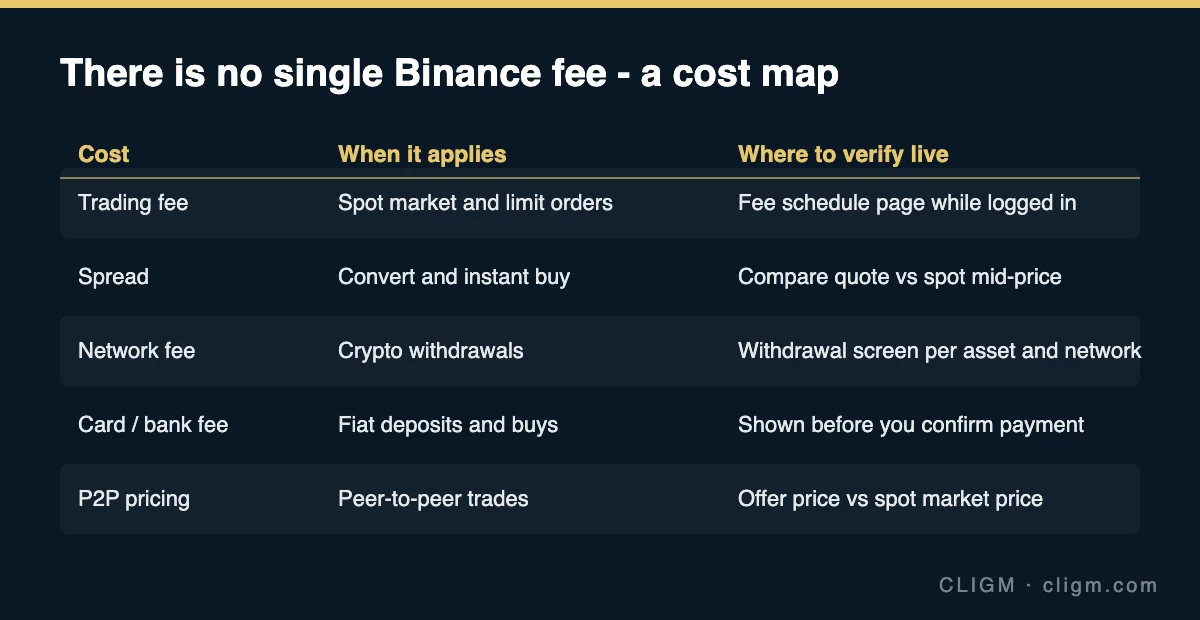
Ask what Binance charges and you will get a different answer from every article you read — because there is no single "Binance fee." There is a family of costs, each triggered by a different action, and most of the fee tables floating around the internet are stale the week they are published. This guide takes a more durable approach: instead of quoting numbers that will drift, it maps every cost category, explains what drives each one, and shows you exactly where to verify the live figure before you pay it.
That last part is the real skill. Fees change with VIP tiers, promotions, regions, payment methods and network conditions; the number that matters is the one shown to your account at the moment of the transaction.
Spot trading fees
When you place an order on the spot market, you pay a percentage of the trade as a maker or taker fee. "Maker" orders add liquidity (limit orders that wait in the book); "taker" orders remove it (market orders that execute immediately) — and takers typically pay slightly more. Your personal rate depends on your VIP tier, whether you pay fees in BNB for a discount, and any promotions active in your region.
Where to verify: the fee schedule page while logged in, which shows your rates, and the order preview itself, which shows the fee before you confirm. If a third-party article and your logged-in fee page disagree, the fee page wins, always.
Convert and the spread
The Convert feature and instant-buy flows advertise "zero fees" — which is true in the narrow sense that no line-item fee appears. The cost lives in the spread: the difference between the rate you are quoted and the market mid-price at that moment. Convenience products bundle their margin into the rate.
This is neither hidden nor scandalous, but it means comparing costs requires one extra step: before accepting a Convert quote, glance at the spot market price for the same pair. The gap between quote and market is your effective fee. For small amounts the convenience often justifies it; for larger amounts, the spot market's explicit fee is frequently cheaper than the invisible spread.
Crypto deposit and withdrawal costs
Crypto deposits are generally free on Binance's side. Withdrawals carry a fee that depends on the asset and the network you choose — the same USDT withdrawal can cost meaningfully different amounts on ERC20, BEP20 and TRC20, because the fee reflects the underlying network's transaction costs, which themselves fluctuate with congestion.
Where to verify: the withdrawal screen, after selecting asset and network, immediately shows the current fee and the exact amount that will arrive. Check it every time rather than relying on memory; network fees are the most volatile cost in this entire map. Choosing a network is also a safety decision, not just a cost decision — the matching rules are covered in BEP20 vs ERC20 vs TRC20.
Card and bank costs
Buying crypto with a card is usually the most expensive route: a card-processing fee is baked into the flow, and your bank may add its own charges — some banks treat exchange purchases as cash advances, with fees and immediate interest. Bank transfers (where supported) are typically cheaper but slower.
Where to verify: the payment preview always shows the total cost and the amount of crypto you will receive before you confirm; compute the effective rate from those two numbers. For the bank-side charges, only your bank's terms can tell you — worth one check before your first card purchase, not after.
P2P pricing
P2P trades show no platform fee for takers in most regions, but the merchant's offer price is the cost: it sits somewhere relative to the spot market price, and that gap is the merchant's margin. Attractive-looking offers can carry restrictive conditions, and offers priced too well to be true are a classic scam lure.
Where to verify: compare the offer price against the live spot price of the same pair before committing. And because P2P's real risks are procedural rather than financial, read our P2P safety checklist before your first trade.
A practical comparison formula
Every route — spot trade plus withdrawal, Convert, card buy, P2P — can be reduced to one honest number:
Effective cost = (what you give − market value of what you receive) ÷ what you give.
Work it out with live numbers at the moment of decision: the fiat you pay versus the market value of the crypto that actually lands (after every fee, spread and network cost), or vice versa for selling. This single formula cuts through marketing framing entirely — "zero fee" routes stop looking free when the spread is counted, and a route with a visible fee is sometimes the cheapest on net. For the specific case of turning crypto back into money in your bank account, we compare the full routes end to end in how to withdraw from Binance to a bank account.
Referral and discount claims
A large share of fee content online exists to funnel you through someone's referral link, and claims about discounts deserve scrutiny in proportion. Some referral structures do share a percentage back; the details vary, change over time, and are ultimately visible only in your own account dashboard after signup. Treat any specific promised percentage from a third party as unverified marketing. The same skepticism applies to "VIP rate" services and anyone offering to trade "through" their account for better fees — the latter is a custody risk dressed as a discount.
The reliable discounts are the boring official ones: BNB fee payment, maker rather than taker execution, and volume tiers, each verifiable on your own fee page.
The habit that replaces every fee table
Before any transaction, one glance: the fee schedule for your tier, the preview screen for this specific action, and — for anything involving a quote — the spot price for comparison. Thirty seconds, live data, no stale tables. That habit will outlast every number in every fee article, including any we could have printed here.
CLIGM is an independent publication, not affiliated with Binance. Fees, tiers and product availability vary by region and change frequently — your logged-in account screens are the only authoritative source. Last reviewed: July 27, 2026.