
Fees & P2P
Binance P2P Safety: A Checklist for Buyers, Sellers and Appeals
Reduce common Binance P2P risks by keeping payment inside the order, verifying names, preserving evidence and using the official appeal process.
Binance P2P connects you directly with another person: you send a bank transfer, they release crypto from escrow, and the platform referees the order. That structure is what makes P2P available in regions without card or bank rails — and it is also what makes P2P the one place on an exchange where procedure matters more than price. The bank payment happens outside the blockchain and outside Binance's control; only the order workflow, the escrow and your evidence protect you. This checklist covers that workflow for buyers, for sellers, and for the moment a dispute starts.
One framing to keep throughout: in P2P, everything legitimate happens inside the order. Nearly every scam begins with a request to step outside it.
Understand the transaction before starting
Complete identity verification first, and use a payment account in your own legal name where required — name-matching between your bank account and your verified identity is both a platform rule in many regions and your strongest evidence in any dispute. Payment methods, availability and rules vary by region; check what applies to yours inside the app rather than assuming.
Understand what escrow does and does not cover: when a buyer opens an order, the seller's crypto is locked by the platform, which protects the buyer from paying for nothing and protects the seller from releasing before payment. Escrow does not verify that a bank transfer is real, cleared or sent by the right person — that verification is your job, on your side of the trade.
Price is the first safety signal. Compare the offer against the live spot price; a merchant's margin is normal, but an offer dramatically better than market is bait, not luck. Our fees guide explains how to read P2P pricing against spot in ten seconds.
Checklist for buyers
Before taking an offer, read the merchant's profile: completion rate, total orders, account age, and the full terms text — conditions like "no third-party payments" or specific reference requirements are binding on you once you open the order.
Then, in order:
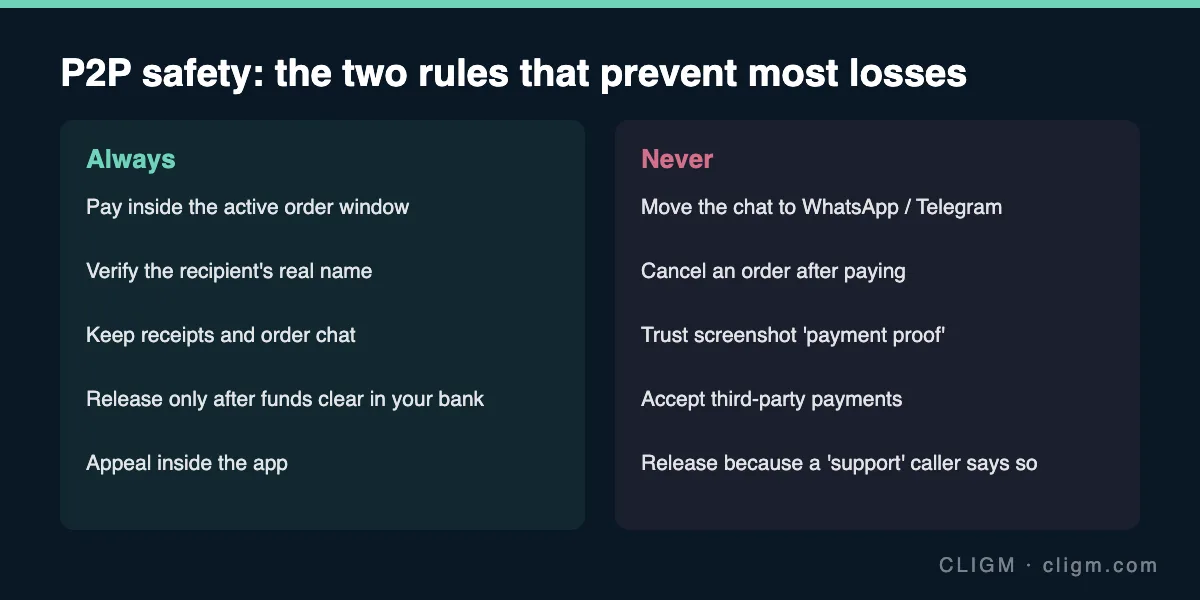
- Open the payment details only inside the active order, and pay only to the account shown there. If the seller's chat message asks you to pay a different account — any reason, any story — stop and cancel.
- Verify the recipient name matches the merchant's verified name shown by the platform.
- Follow reference instructions exactly. Do not write "crypto" or "USDT" in a bank reference unless instructed; do not improvise.
- Send the payment from an account in your own name — third-party payments violate most merchants' terms and void your standing in disputes.
- Mark "paid" only after you have actually sent the money, and keep the bank receipt with its transaction reference.
- If the timer runs low or the seller goes quiet after you paid, never cancel the order — a cancelled order releases the escrow back to the seller while your money is already gone. Open an appeal instead and wait.
Checklist for sellers
The seller's entire risk concentrates in one moment: the release. Release crypto only after you have confirmed that cleared funds are visible inside your own banking app or online banking, logged in independently — not in a screenshot, not in an SMS alert, not in an emailed "payment confirmation." All three are trivially forged, and fake-proof-of-payment is the single most common P2P scam worldwide.
Check the payer's name against the buyer's verified name, and the amount to the cent. Watch for the overpayment play — the buyer "accidentally" sends too much and asks for a refund to a different account; the original payment later reverses, and the refund is your loss. Anything irregular: keep the order open, refuse improvised fixes, and let the appeal process handle it.
And the rule that defeats the most dangerous script of all: never release because a caller, chat message or email claiming to be "Binance support" tells you to. Platform decisions appear inside the order and the official app — support does not phone sellers to demand releases.
If a dispute starts
Appeals are decided on evidence, so behave from the first minute as if an arbitrator will read everything — because one will.
Keep every message inside the order chat; conversations moved to WhatsApp or Telegram are invisible to the platform and worthless in appeal. State facts chronologically, without insults or threats. Upload complete evidence: order ID, payment timestamp, payer and recipient names, amount, bank reference, and — strongest of all — a screen recording navigating your real banking session, with passwords and codes off-screen. Never edit or crop evidence in ways that hide context; doctored evidence sinks otherwise-winnable appeals. Then respond promptly to arbitration requests and wait — appeals take time, and impatience is what the other side's script is counting on.
Do not retaliate by publishing the other party's banking details or identity on social media; it can create legal liability for you and does not move your appeal.
Common scam patterns
Every pattern below appears constantly, and each one is defeated by a rule you have already read:
- "Cancel the order, I'll pay you directly" — after you paid. Cancelling releases escrow to the seller.
- "Let's talk on WhatsApp/Telegram" — moves evidence off-platform.
- Fake payment screenshots and SMS alerts — verify in your own bank, never in images.
- Third-party payment in, or refund to a stranger's account out — the reversal play.
- "Send a second transfer to unlock the first" — no such mechanism exists anywhere.
- "Binance support" calling about your order — support does not call.
- Pressure to hurry — urgency is the signature of every script.
Notice the common core: each one needs you to act outside the order, outside your own bank, or outside your own judgment.
Regional and banking considerations
Your bank has its own view of P2P activity. Frequent transfers to strangers can trigger fraud reviews or account questions, and misdescribing a payment's purpose to dodge a bank's crypto policy is a serious mistake — it hands the counterparty leverage and puts you on the wrong side of your bank's terms. Know your local rules on crypto trading and taxation before trading at scale, and if P2P is unavailable in your region or on your account, do not borrow someone else's identity or payment account to reach it; that converts a limitation into a liability. New accounts should also complete the security checklist before trading — P2P scammers actively target accounts with weak protection.
The safest default
Stay inside the official order. Verify names. Verify cleared funds in your own bank. Keep evidence. Appeal in the app. And if the other party asks you to break the workflow — any step, any story — the trade is over; walk away from the order, not from your money. If your goal is moving funds to your bank rather than trading, compare P2P against the other routes in how to withdraw from Binance to a bank account first.
CLIGM is independent and not affiliated with Binance. We cannot intervene in orders or appeals; rules and availability vary by region — the in-app terms are the authority. Last reviewed: July 27, 2026.