
Deposits & Withdrawals
Binance Withdrawal Limits Explained: Why Yours Differs and What Changes It
There is no single 'Binance withdrawal limit' — yours is set by verification level, security setup, account history and region. Here is what moves each lever, and what never does.
Search "Binance withdrawal limit" and you will find confident numbers that contradict each other — because there is no single number to find. Your limit is assembled from several account-specific factors, displayed in exactly one authoritative place: your own withdrawal screen. This guide explains what sets the limit, which levers actually raise it, why it sometimes drops temporarily, and why every "workaround" is a trap. Deliberately, there are no specific figures here — any number we printed would be wrong for someone, somewhere, within months.
The main lever: verification level
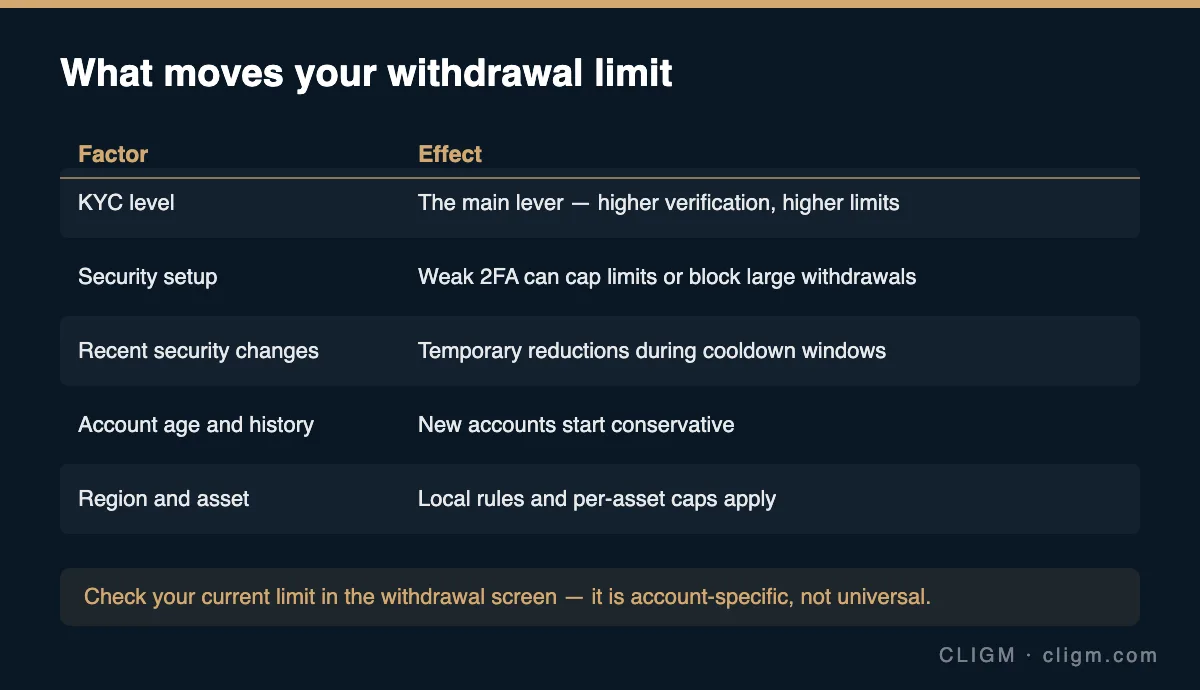
Withdrawal capacity is fundamentally a KYC feature. Unverified or minimally verified accounts get little to nothing; standard identity verification unlocks the limits most users live within; higher tiers — address proof, enhanced due diligence — raise ceilings further, mostly mattering for large-volume users. If your limit feels tight, this is the first place to look: the verification section of your account shows your current tier and what the next one requires. Timelines for those reviews run from minutes to days — set expectations with how long verification takes.
Two details people miss. Limits are typically calculated over a rolling 24-hour window, not a calendar day — "my limit reset at midnight" is a common false assumption that makes people think their limit shrank. And limits are usually denominated in a reference currency across all assets combined, so several mid-sized withdrawals of different coins draw down the same shared ceiling.
The lever nobody expects: security setup
Your security configuration can gate withdrawal capacity directly. Accounts with weak setups — SMS-only 2FA, no authenticator — may face tighter effective limits or extra friction on large withdrawals, because the platform's willingness to move money tracks its confidence that you are you. Upgrading to an authenticator app or passkey, enabling an anti-phishing code, and maintaining a clean device list is not just protection; it is infrastructure for higher limits. The whole upgrade takes minutes — see the 15-minute security checklist.
Address whitelisting deserves special mention: pre-approving withdrawal addresses (with a lock-in delay for new entries) makes large withdrawals to known destinations far less likely to trip risk reviews — effectively raising your practical limit even where the nominal one is unchanged.
Temporary reductions: cooldowns and risk holds
If your limit suddenly seems lower — or withdrawals stop entirely — the cause is usually temporal, not structural. Recent password, 2FA or email changes start fixed cooldown windows during which withdrawals are paused or capped; unusual withdrawal patterns can trigger reviews that hold specific transactions; disputes freeze disputed amounts. These expire or resolve; they are not your new limit. The triggers and typical durations are mapped in risk-control withdrawal holds. The practical advice compresses to one line: plan large withdrawals away from security changes — do your device migrations and password rotations, let the cooldown clear, then move funds.
History, region and asset
Three quieter factors. Account age and behavior: newer accounts start conservative; a history of normal activity loosens practical friction over time — one more argument against creating a fresh account to "reset" a problem. Region: local regulation caps or shapes limits in some jurisdictions, and fiat-channel limits (bank withdrawals) are a separate system from crypto withdrawal limits — a distinction that surprises people moving money out to banks, covered in withdrawing to a bank account. Per-asset and per-network constraints: individual assets can carry their own minimums and maximums per transaction, and network conditions (like a chain under maintenance) can zero out a specific asset's withdrawals while everything else works.
Raising your limit, in order of effectiveness
- Complete the next verification tier — the only step that raises the nominal ceiling substantially.
- Harden security — authenticator/passkey, anti-phishing code, whitelisting — to stop losing practical capacity to friction and reviews.
- Let cooldowns expire before large movements; check for active holds if today's capacity looks wrong.
- Split large withdrawals across the rolling window — legitimate and expected; the window is a feature, not a dare.
- For genuinely large ongoing volume, look into the platform's higher-tier or institutional programs rather than improvising.
What never works
The workarounds all fail the same way. Multiple accounts to multiply limits: account linkage detection is good, and multi-accounting converts a limit problem into a terms-violation problem — see account locked causes. Borrowed accounts: using someone else's higher-tier account puts your funds legally and practically in their hands, and both accounts at risk. VPN region-shopping for better limits: region mismatches with your KYC documents trigger exactly the compliance reviews that freeze accounts. The pattern: limits are enforced by systems that assume evasion attempts are fraud, because statistically they are.
One closing reframe: for most users most of the time, the binding constraint is not the nominal limit — it is friction from weak security and poorly-timed withdrawals. Fix those two, and the limit you already have usually stops being the problem.
CLIGM is an independent site and is not affiliated with Binance. Limit structures, tiers, windows and regional rules vary by account and change over time — the withdrawal screen in your own account is the only authoritative source for your numbers. Last reviewed: July 27, 2026.