
Deposits & Withdrawals
Sent Crypto on the Wrong Network? What Is Recoverable on Binance
Wrong network, missing memo, unsupported chain — each mistake has a different recovery chance. Sort your case first, then follow the path that actually applies to it.
The transfer left, the TXID confirms on-chain, and the balance never appears — because the funds traveled on a network the destination was not expecting. This is the most feared beginner mistake in crypto, and the internet answers it badly: half the sources say "your funds are gone forever", half say "support will fix it". The truth is that recovery depends entirely on which scenario you are in, and the first job is to identify yours precisely.
One rule holds for every scenario: only the party who controls the destination address can recover anything. Not the sender, not the network, and no third-party "recovery expert" — memorize this line, because it also identifies every recovery scam on sight.
First, establish the facts
Before judging your case, collect four things: the TXID, the network the transaction actually used (shown in the sending platform's history and on the block explorer), the destination address, and the asset and amount. Check the TXID on the correct network's explorer — how to do that, and how to avoid fake explorers, is covered in the deposit troubleshooting guide. With those facts, find your scenario below.
Scenario 1: right network, missing or wrong memo
You sent an asset that requires a memo/tag (the classic shared-address setup) to the correct network, but the memo was missing or mistyped. This is the most recoverable case. The funds arrived at an address the platform controls — they just could not be routed to your account automatically. Binance provides a self-service recovery flow for missing-memo deposits: you supply the TXID and details, verification happens, and the deposit is credited manually. Expect it to take longer than a normal deposit and possibly involve a fee, but the success rate for legitimate cases is high.
Scenario 2: deposit to Binance on an unsupported network
You withdrew from another platform to your Binance deposit address, but chose a network Binance does not list for that asset. The good news: the destination address is still controlled by Binance. The bad news: crediting it requires manual intervention on infrastructure not built for that path — which is why this recovery is possible but slow, not guaranteed, and sometimes fee-bearing. Open a support ticket through the official app with your TXID, networks involved, asset and amount. Then be patient: cross-network recoveries are measured in weeks, and no amount of follow-up tickets accelerates the engineering work behind them. Whether recovery is offered at all can depend on the asset, the network pair, and the amount.
Scenario 3: withdrawal from Binance to the wrong network
You withdrew from Binance and picked a network the receiving platform or wallet does not support. Now the funds sit at an address controlled by the receiver — so Binance can no longer help; its part completed correctly on-chain. Your path runs through the receiving side:
- Receiving platform (exchange): contact their support with the TXID. Some platforms recover deposits from unsupported-but-compatible networks (for a fee, slowly, case by case). Some do not. Their policy decides.
- Your own wallet: if you control the destination's seed phrase, recovery is often possible by importing the wallet on the network the funds actually traveled — the same address frequently exists on multiple EVM chains. This requires care; research the exact steps for your wallet and never type your seed phrase into a website that offers to do it for you.
- Someone else's wallet: you are dependent on their cooperation and competence.
Scenario 4: contract, burn, or nonexistent address
If the destination was a token contract address, a burn address, or an address nobody controls, recovery is effectively impossible — no one holds the keys. This is rare in exchange-to-exchange transfers (deposit addresses are always real accounts) and mostly happens with manual copy-paste errors into self-custody wallets. Treat the amount as tuition, and re-read the prevention section below.
The recovery-scam layer
Every public complaint about lost funds attracts replies within minutes: "contact @CryptoRecoveryPro, they got mine back!" Understand this clearly — on-chain transactions cannot be reversed by anyone, and the only parties who can credit a stuck deposit are the platforms that control the addresses involved. Every third-party recovery service is one of: an advance-fee scam, a phishing operation for your documents and keys, or both. The tell is always the same: they contact you, they guarantee success, and they need payment or your seed phrase upfront.
Prevention costs thirty seconds
Every scenario above is prevented by the same short ritual, done on every transfer: open the receiving side's current deposit screen, copy the address and network from there, select the same network on the sending side, check whether a memo is required, and send a small test amount first for any new route. The full logic of choosing between BEP20, ERC20 and TRC20 — and why matching networks matters more than cheap fees — is in how to choose the right network. For the outbound direction, the pre-withdrawal checklist in withdrawal status guide covers the same ground.
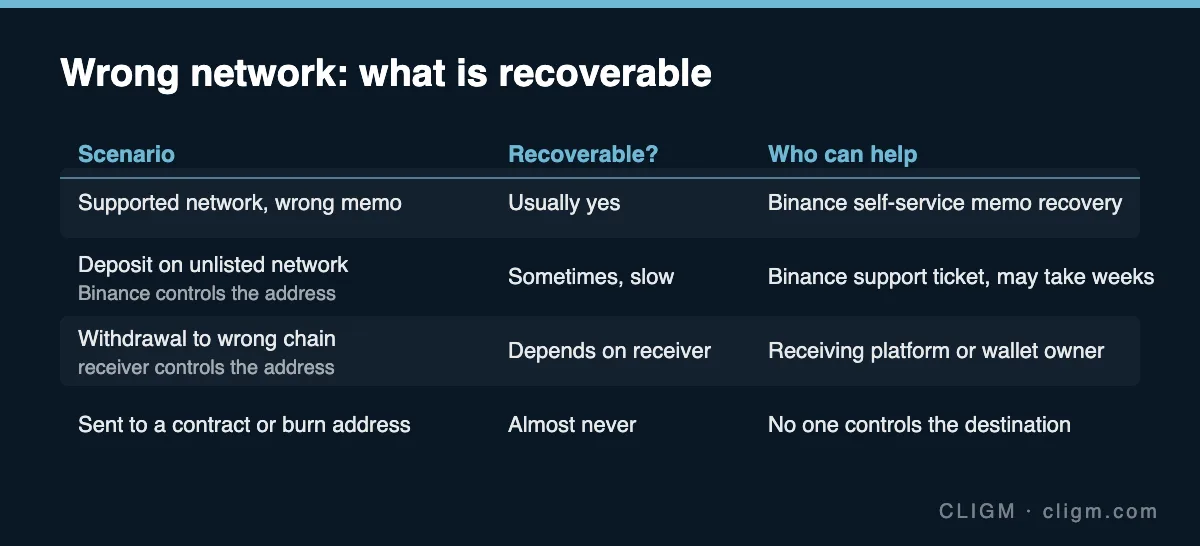
| Scenario | Recoverable? | Who to contact |
|---|---|---|
| Right network, wrong/missing memo | Usually yes | Binance self-service recovery |
| Deposit on unsupported network | Sometimes, slowly | Binance support, official app only |
| Withdrawal to wrong chain | Depends on receiver | Receiving platform or wallet owner |
| Contract or burn address | Almost never | No one controls the destination |
CLIGM is an independent site and is not affiliated with Binance. Recovery availability, fees and timelines vary by asset, network, amount and region, and policies change — the official support flow's answer for your specific case is authoritative. Last reviewed: July 27, 2026.