
Fees & P2P
Binance P2P Appeals: How Disputes Actually Get Decided
P2P disputes are decided on verifiable evidence, not on who complains loudest. How escrow protects you, what evidence wins, and the mistakes that lose winnable cases.
The moment a P2P trade goes wrong — you paid and the seller went silent, or you are the seller and the "payment" looks fake — your outcome is no longer decided by the counterparty. It is decided by an appeal process that runs on verifiable evidence and platform records. People lose winnable cases not because the process is unfair, but because they damage their own evidence before the case starts. This guide covers how the process actually works, what wins, and the handful of mistakes that lose.
The foundation first: in every P2P order, the crypto sits in platform escrow from order creation until release. The seller cannot take it back mid-order; the buyer cannot take it without release. Every dispute is ultimately one question: does the evidence show the fiat payment happened as the order required? Escrow means time pressure is fake — which is why every scam script tries to manufacture urgency.
Before appealing: make sure it is a dispute
Most "disputes" are delays. Banks take time; a transfer marked instant can land in minutes or hours depending on rails and cutoff times; a seller may be away from notifications. Use the order chat first, stay polite, and watch the order timer — the appeal option becomes available when the timer allows. Appealing a trade that is merely slow is not harmful, but chatting first resolves most cases faster.
What is never just a delay: a counterparty asking you to act outside the order's rules — cancel after paying, release before money arrives, continue in another app, pay a different account. Those are scam scripts, and the correct response is to stop and appeal, covered in the P2P safety checklist.
Filing: what actually persuades
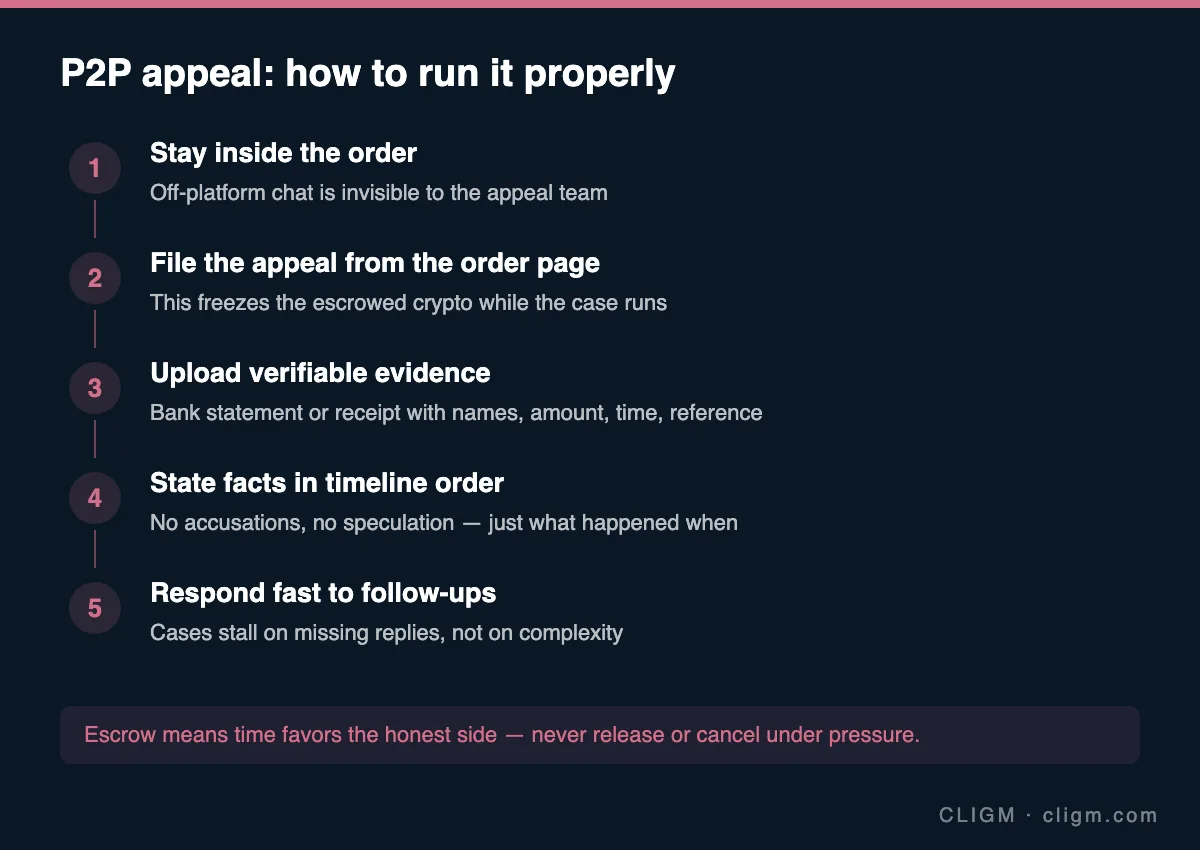
File from inside the order page — this attaches the appeal to the order record and keeps the escrow frozen while the case runs. Then build your submission around one principle: reviewers can verify platform records instantly, and your job is to connect the off-platform part (the bank payment) to those records with evidence that can be checked.
Strong evidence: a bank statement or official receipt showing payer and payee names, the amount, timestamp, and transaction reference — ideally as an export or screen recording from inside your banking app, not a cropped screenshot. Weak evidence: cropped images, "pending" screenshots (in-progress is not received), and anything the other side can claim was edited. As the buyer, your payment record is your case. As the seller, your evidence is often an absence — a statement for the relevant period showing the money never arrived — plus the fake receipt the buyer sent, if any.
Write the narrative in timeline order, facts only: order created at X, payment sent at Y via Z, marked paid at W. No accusations, no speculation about the counterparty's motives — reviewers extract facts, and emotion just slows the extraction.
While the case runs
Three rules. Respond fast: appeals stall on unanswered follow-up requests far more than on case complexity; check app notifications daily. Keep everything in the order chat: off-platform conversations are invisible to reviewers and, worse, moving there mid-dispute reads as suspicious behavior. Do not touch the order state: no canceling, no releasing "as a gesture of goodwill", no side deals with the counterparty to "settle directly" — a settlement that bypasses the appeal usually means the scammer keeps escrow and you keep a promise.
Timelines run from hours to days depending on complexity and how quickly both sides supply evidence. A case where one side goes silent typically resolves in favor of the side that showed up with records.
The mistakes that lose winnable cases
- Releasing before verifying — the seller's fatal error. A fake SMS or doctored receipt convinces you, you release, and there is nothing left to dispute: escrow is gone. Only your own banking app, logged into directly, counts as verification.
- Canceling after paying — the buyer's fatal error. Cancellation returns escrow to the seller; if you already paid, you have converted a protected trade into an unprotected donation. No matter who asks, however reasonable it sounds: never cancel an order you have paid on.
- Marking paid without paying (or before the transfer actually executes) — destroys your credibility for the whole case and can earn restrictions on its own.
- Paying from someone else's account — most order terms require payment from an account in your verified name. Third-party payment gives the counterparty a legitimate reason to refuse, and reviewers will side with the order's terms.
- Evidence hygiene failures — deleting chats, editing screenshots, or public shaming with the counterparty's bank details (which can violate rules independently of your dispute).
After the decision
Decisions release escrow to whichever side the evidence supported. If you win as buyer, the crypto arrives; if you lose and believe the review missed something, you can escalate through official support with new evidence — repetition without new material rarely changes outcomes. If you were scammed with a fake payment and the case exposes it, the counterparty faces platform consequences; separately, file with your bank and police — banks can sometimes claw back domestic transfers, and formal reports matter for that. Note that disputed funds and related feature access can stay restricted while cases run — the mechanics of dispute-linked holds appear in risk-control withdrawal holds.
One last calibration: thousands of P2P trades complete uneventfully every day, and the appeal system exists precisely so that the rare bad one lands on evidence rather than on trust. Trade as if you will need to prove everything, and you almost never will.
CLIGM is an independent site and is not affiliated with Binance. P2P availability, order rules and appeal flows vary by region and change over time — the rules shown in your order and the official appeal interface are authoritative. Last reviewed: July 27, 2026.